





SAREF4DMGT ontology and semantics
Introduction and overview
The objective of SAREF4DMGT is to extend the SAREF ontology (see ETSI TS 103 264 [1]) for the Device Management (DM) domain. Clause 4.1 of the present document shortly introduces a high-level view of the envisioned SAREF4DMGT semantic model, with the retained concepts (i.e. classes) and their relations.
The Device Management (DM) domain consists in the remote administration of devices for an operator, such as a service provider or device manufacturer.
The proposal for an ontology for standardization in Device Management is motivated by the need to address challenges arising from the evolution of DM and the emergence of the Internet of Things (IoT).
Initially, DM was introduced by manufacturers and telecommunication operators to ensure the proper functioning of devices like gateways and set-top boxes, focusing on firmware management due to the high replacement costs of these devices. Over time, the scope of DM expanded to include configuration and customer care, enabling Telcos to configure value-added services, improve Quality of Service, and reduce costs.
With the rise of the IoT, the DM landscape has shifted significantly. The proliferation of heterogeneous IoT devices and the temptation to produce disposable devices have highlighted the need for remote management for economic and ecological reasons. However, existing DM solutions face challenges due to the scale and diversity of IoT devices, as well as the prevalence of proprietary protocols and siloed solutions from various manufacturers. This has created issues with heterogeneity in device capabilities, DM protocols, and management solutions.
Standardization becomes essential to simplify device integration and DM operations, benefiting both operators and manufacturers.
The proposed IoT Device Management Ontology provides an abstract semantic model of DM domain-specific concepts, enabling cross-system data interoperability and knowledge enrichment through reasoning. This ontology aims to unify and streamline IoT DM practices, overcoming the limitations of existing approaches.
Therefore, the SAREF4DMGT ontology shall allow:
- The representation of the device management capabilities of a device, with their associated functions and commands.
- The representation of the information needed to select which command to execute on a device for a targeted function.
- The representation of the information retrievable from the device and exposed by the DM server.
The SAREF4DMGT extension has been specified and formalized by investigating Device Management standard protocols, such as BBF CWMP [4], BBF USP [5], oneM2M [6] or OMA LwM2M [7].
SAREF4DMGT mainly reuses the SAREF ontology (see ETSI TS 103 264 [1]) and is developed according to the SAREF Developmebt Framework and Workflow (see ETSI TS 103 673 [3]). The SAREF4DMGT ontology is fully specified and formalized in Clause 4.2 of the present document. Figure 1 presents the high-level view of the envisioned model of SAREF4DMGT ontology. In Figure 1, classes directly imported from the SAREF ontology are in yellow, classes specifically developed for SAREF4DMGT are in blue.
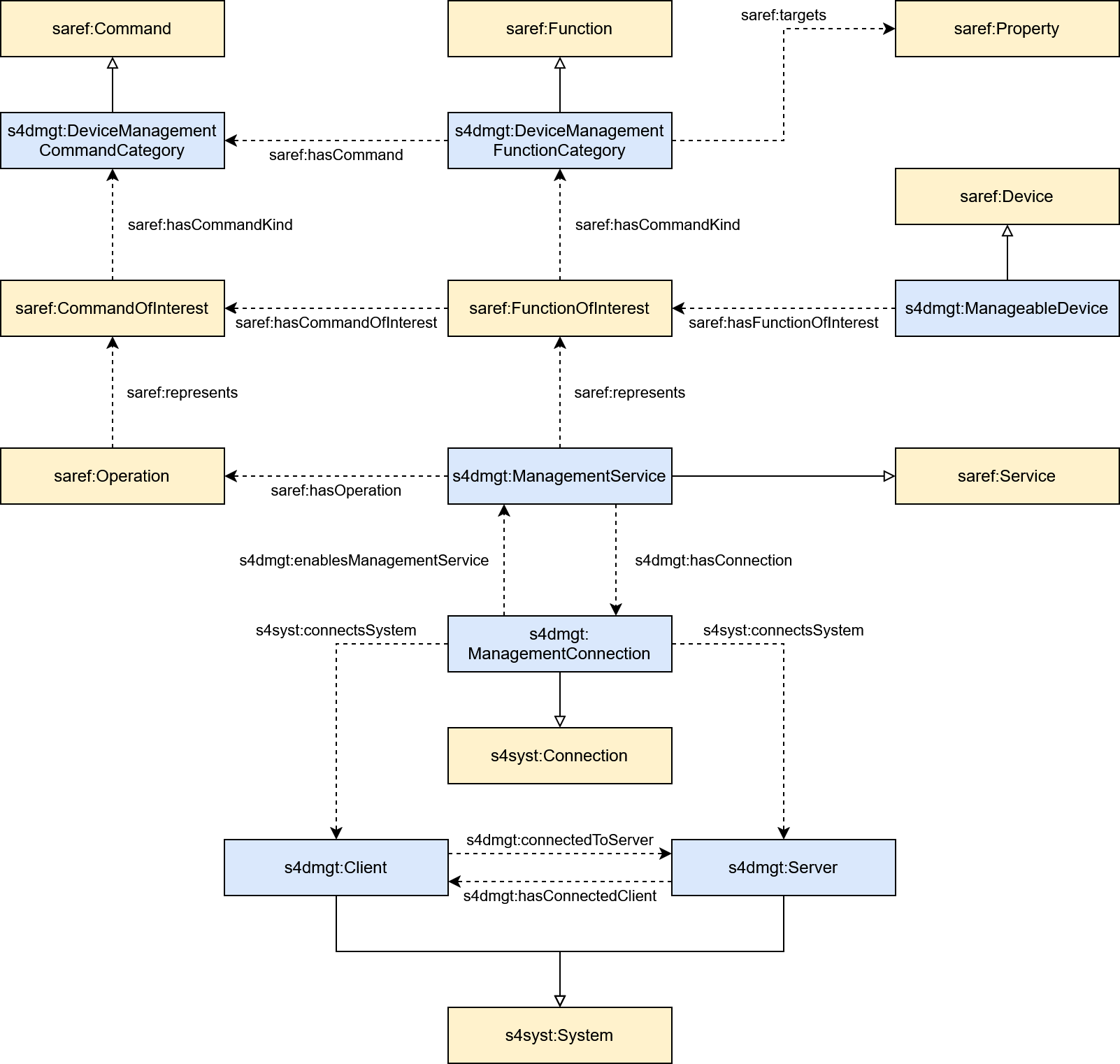
Within Figure 1, as well as within all the figures that are depicted in clause 4 of the present document, the following conventions are used:
- arrows are used to represent properties between classes and to represent some RDF, RDF-S and OWL constructs, more precisely:
- plain arrows with white triangles represent the rdfs:subClassOf relation between two classes. The origin of the arrow is the class to be declared as subclass of the class at the destination of the arrow;
- dashed arrows between two classes indicate a local restriction in the origin class, i.e. that the object property can be instantiated between the classes in the origin and the destination of the arrow. The identifier of the object property is indicated within the arrow;
- dashed arrows with no identifier are used to represent the rdf:type relation, indicating that the element in the origin of the arrow is an instance of the class in the destination of the arrow;
- datatype properties are denoted by rectangles attached to the classes, in an UML-oriented way. Dashed boxes represent local restrictions in the class, i.e. datatype properties that can be applied to the class they are attached to;
- individuals are denoted by rectangles in which the identifier is underlined.
SAREF4DMGT is extending the SAREF ontology for the Device Management domain and thus shall logically mainly model the following concepts (i.e. classes within Figure 1):
- Manageable Device: A tangible object that has at least one Device Management Function. This class extends the saref:Device class, it is a Feature of Interest by definition.
- Server: A DM Server is the software entity which is responsible for performing DM operations on a fleet of Devices. It exposes the set of available operations to an entity that needs to trigger an operation, such as a manufacturer or a Customer Care service. The DM Server is a endpoint, generally secured, with which DM Clients communicate. The protocol used between Server and Client is not in the scope of this ontology. It can follow a DM standard such as CWMP or LwM2M, or be completely proprietary.
- Client: Software entity which represents a Device by exposing its DM Functions to one or more DM Server(s). It is responsible for the triggering of the DM Functions when a Command targeting the represented Device is received by the Server. The Client is also responsible for the reporting of the results of the Function execution to the Server. The Client has an identifier that is unique only relatively to each Server it is connected to.
- Device Management Capabilities: these capabilities are represented through categories of saref:Function and saref:Command. These capabilities rely on a set of high-level DM-specific device resources, namely the identity, firmware, packages, and modules. These resources can be manipulated through lower-level representations, namely the Supported Datamodel, and the Datamodel Parameters.
- Device Management Function Category: Category of saref:Function corresponding to the capabilities of the Device to perform its own diagnostics, maintenance, configuration, monitoring and control.
- Device Management Command Category: Category of saref:Command associated to Device Management Functions.
- Management Service: A saref:Service that represents functions or functions of interest of the Device Management Function Category. The Management Service for a function only exists when a Management Connection connects a Client and a Server that can expose this function.
- Management Connection : Abstract representation of the connection between a DM Client and a DM Server. It does not necessarily imply that a persistent connection is established between the entities, such as a TCP connection. It represents the link and the capability of the Server to interact with the Client. For instance, the Client has been authenticated by the Server with a certificate, and/or the client has received a configuration for access rights to its functions for the Server.
| Prefix | Namespace |
|---|---|
| dcterms | http://purl.org/dc/terms/ |
| foaf | http://xmlns.com/foaf/0.1/ |
| owl | http://www.w3.org/2002/07/owl# |
| rdf | http://www.w3.org/1999/02/22-rdf-syntax-ns# |
| rdfs | http://www.w3.org/2000/01/rdf-schema# |
| s4dmgt | https://saref.etsi.org/saref4dmgt/ |
| s4syst | https://saref.etsi.org/saref4syst/ |
| saref | https://saref.etsi.org/core/ |
| skos | http://www.w3.org/2004/02/skos/core# |
| vann | http://purl.org/vocab/vann/ |
| xml | http://www.w3.org/XML/1998/namespace |
| xsd | http://www.w3.org/2001/XMLSchema# |
SAREF4DMGT
Introduction
As already introduced in clause 4.1 of the present document, SAREF4DMGT is an OWL-DL ontology that describes the domain of Device Management. To this end, multiple concepts need to be introduced.
First, SAREF4DMGT relies on a set of SAREF-defined concepts, which are saref:Function, saref:Command, and saref:Service. The Function is specialized to represent DM-specific capabilities, while the Command enables the representation of the exposition of these DM-specific capabilities. Finally, the Service is instantiated with a DM Service, that encompasses the set of functions related to DM.
These base concepts allow the representation of Device Management specific entities, which were extracted from the analysis of the major standards used for Device Management by Telecommunication Operators. For the purpose of the present document, the following standards were analyzed:
- BBF CWMP: The Customer Premises Equipment Wide Area Network Management Protocol [4] was created by the BroadBand Forum to address the Device Management requirement of Telecommunication Operators, with a specialization on gateway fleets management. While the protocol itself is defined in the Technical Report 069, the datamodel of devices is described in the Technical Report 181 [5].
- BBF USP: The User Services Platform [6] is the direct evolution of CWMP at the BroadBand Forum. The core principles are updated to allow a decentralized architecture compared to CWMP, with shared management through Access Control Lists.
- OMA LwM2M: The LightWeight Machine-to-Machine protocol [7] from the Open Mobile Alliance is a standardized protocol for remote device management, telemetry, and secure communication in IoT ecosystems. LwM2M enforces interoperability through standardized capabilities with registries [i.1] promoting the reuse of resources across vendors and manufacturers.
- oneM2M: oneM2M [8] brings together all components in the IoT solution stack. It avoids reinvention in favor of reusing existing technology components and standards. oneM2M’s architecture defines a common middleware technology in a horizontal layer between devices and communications networks and IoT applications. This standardizes links between connected devices, gateways, communications networks and cloud infrastructure. For the purpose of the present document, the following specifications were explored: "Management enablement (OMA)" [9], "Management enablement (BBF)" [10], "LwM2M Interworking" [11], and "SDT based Information Model and Mapping for Vertical Industries, section 5.8 Device Management" [12].
The SAREF4DMGT ontology represents the set of physical and software entities involved in Device Management, such as Manageable Device, Client, Server, Connection and Service.
The SAREF4DMGT ontology also models the following specific device capabilities to operate Device Management: Identity, Firmware, Package, Module, Device Control.
Finally, the SAREF4DMGT ontology models the technical representation of these capabilities in the different protocols. These capabilites are exposed as datamodels, hierarchical and technical data structures exposing parameters with their related types and available operations, represented as primitives. Thus, two concepts are introduced: Supported Datamodel, and Datamodel Parameters.
Domain resources
General overview
The Device Management domain involves the following entities: Manageable Device, Client, Server, Connection and Service. They are necessary to enable the discovery and control of Management functions remotely for a Device Management Operator.
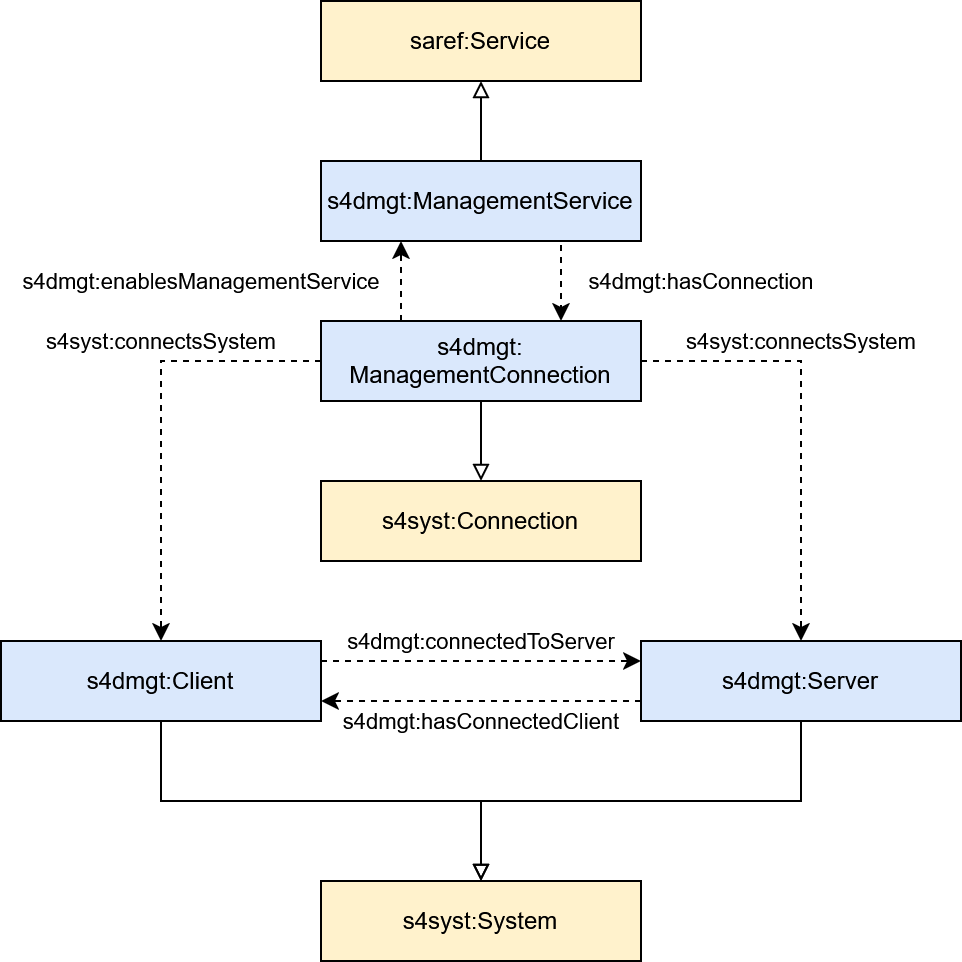
The architecture of Device Management systems consists in a client/server architecture, where the client is responsible for the local activation of functions, while the server is the remote, secure endpoint that enables the connection with the Information System of the operator. The representation of this connection relies on the SAREF4SYST patterns [2].
Devices are managed as fleets as well as individuals, whether for fleet-wide campaigns such as firmware upgrades, or specific actions, e.g. diagnostics destined to Customer Care.
While this architecture used to be centralized with a single server managing every device of the fleet, for instance with CWMP, newer standard protocols introduce shared management of devices, with multiple actors, servers, and access rights for each resource.
Manageable Device
Specialization of saref:Device, the s4dmgt:ManageableDevice is a saref:FeatureOfInterest that consists in a device that supports at least one Device Management function, exposed through a command.
Client
The client of a device is a s4syst:System which exposes the DM Functions of this device to one or more DM Servers. The relationship linking a s4dmgt:Client to the s4dmgt:Device is the s4dmgt:representsDevice object property, and its inverse s4dmgt:isRepresentedBy. A client is responsible for a single device, while a device may be managed through multiple clients.
Server
The s4dmgt:Server is a s4syst:System, hosted in the network, which is the secured endpoint with which any s4dmgt:Client communicate. The Server is responsible for performing fleet-wide operations. The Server is the entity that exposes the set of available commands to DM Operators of manufacturers, telecommunication operators, or Customer Care services.
Management Connection
The s4dmgt:ManagementConnection is a s4syst:Connection that is the abstract representation of the connection between a s4dmgt:Client and a s4dmgt:Server. The s4dmgt:Connection can also provide metadata on the existing link between client and server, such as specific authentication or encryption schemes shared by these two entities.
These metadata are freely extensible to any implementation requirements. For instance, Connections are not limited to direct Client-to-Server connections, but also include broker-based architectures such as message-oriented middlewares.
A s4dmgt:Client may be connected to multiple s4dmgt:Server, with the restriction of a single s4dmgt:ManagementConnection for any pair s4dmgt:Server/s4dmgt:Client.
Management Service
A saref:Service that represents functions or functions of interest of the Device Management Function Category.
The s4dmgt:ManagementService exposes these functions through a Connection, between a Client and a Server.
s4dmgt:ManagementService and s4dmgt:ManagementConnection are linked through two object properties, s4dmgt:enablesManagementService and its inverse s4dmgt:hasConnection, which underline the fact that a Management Service only exists through its underlying Management Connection.
DM Capabilities
General overview
The list of DM capabilities comprises the following entities: Identity, Firmware, Package, Module, Device Control. Each resource is described in detail in this clause.
Following the SAREF pattern [1], capabilities are each modeled as a specific saref:Function which specializes the s4dmgt:DeviceManagementFunctionCategory.
Their related properties are each modeled as an individual of a saref:Property which specializes a single property, e.g. DeviceIdentityProperty, through a skos:narrower object property.
All Device Management related commands specialize the s4dmgt:DeviceManagementCommandCategory. In particular, the commands related with a capability are each modeled as a specific saref:Command which specializes their dedicated command category, e.g. s4dmgt:DeviceIdentityCommandCategory.
Identity
The s4dmgt:DeviceIdentityFunction corresponds to the capability of a device to expose a set of resources allowing the identification of that specific device among a fleet of devices. This identification can rely on a set of parameters combined to guarantee uniqueness.
A property associated with the s4dmgt:DeviceIdentityFunction function has a relationship skos:narrower with the property s4dmgt:DeviceIdentityProperty. The list of identified properties comprises the following individuals: s4dmgt:Manufacturer, s4dmgt:HardwareVersion, s4dmgt:ModelName, s4dmgt:ModelNumber, and s4dmgt:SerialNumber. This list is not exhaustive and is meant to be extended depending on the requirements of the Device Management Operator and their fleet.
The commands associated with the s4dmgt:DeviceIdentityFunction specialize the s4dmgt:DeviceIdentityCommandCategory, and comprise the following individual: s4dmgt:DeviceInfoRetrievalCommand.
Firmware
The s4dmgt:FirmwareManagementFunction (see Figure 3) enable the management of the firmware for a device, i.e. the program embedded within that device, loaded and executed at startup, which enables hardware access and control, enabling any device service.
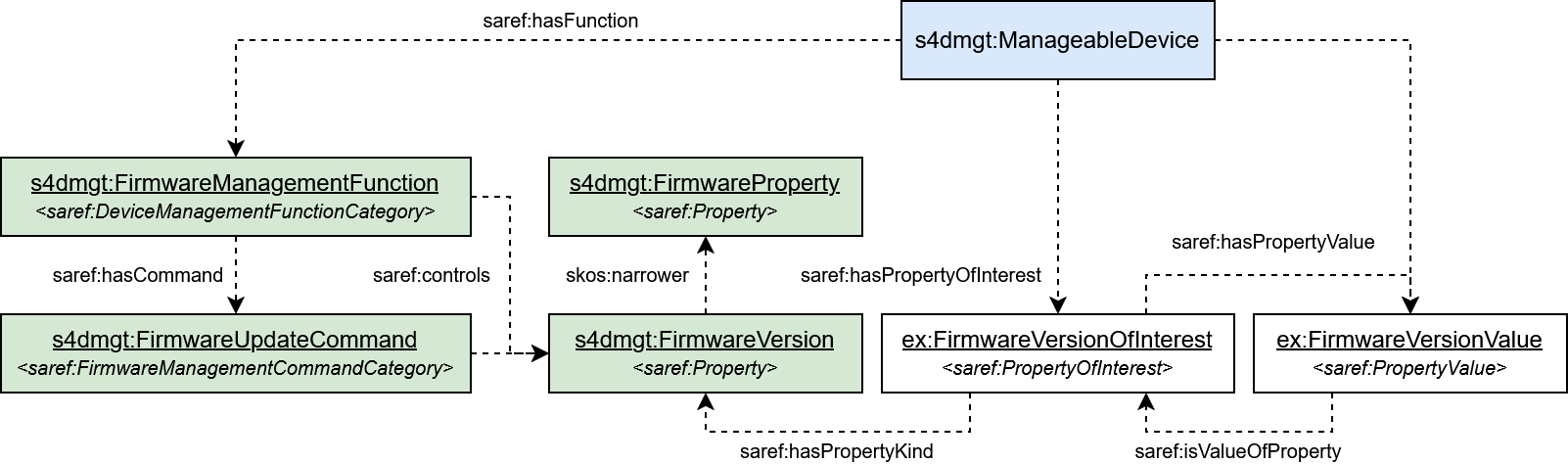
A property associated with the s4dmgt:FirmwareManagementFunction function has a relationship skos:narrower with the property s4dmgt:FirmwareProperty. The list of identified properties comprises the following individual: s4dmgt:FirmwareVersion.
The commands associated with the s4dmgt:FirmwareManagementFunction specialize the s4dmgt:FirmwareManagementCommandCategory, and comprise the following individuals: s4dmgt:FirmwareInformationRetrievalCommand, and s4dmgt:FirmwareUpdateCommand.
Package
The s4dmgt:PackageManagementFunction (see Figure 4) enables the management of packages for a device. A s4dmgt:DevicePackage is a saref:FeatureOfInterest that represents an archive file that may contain resource files, code, libraries or executable files.
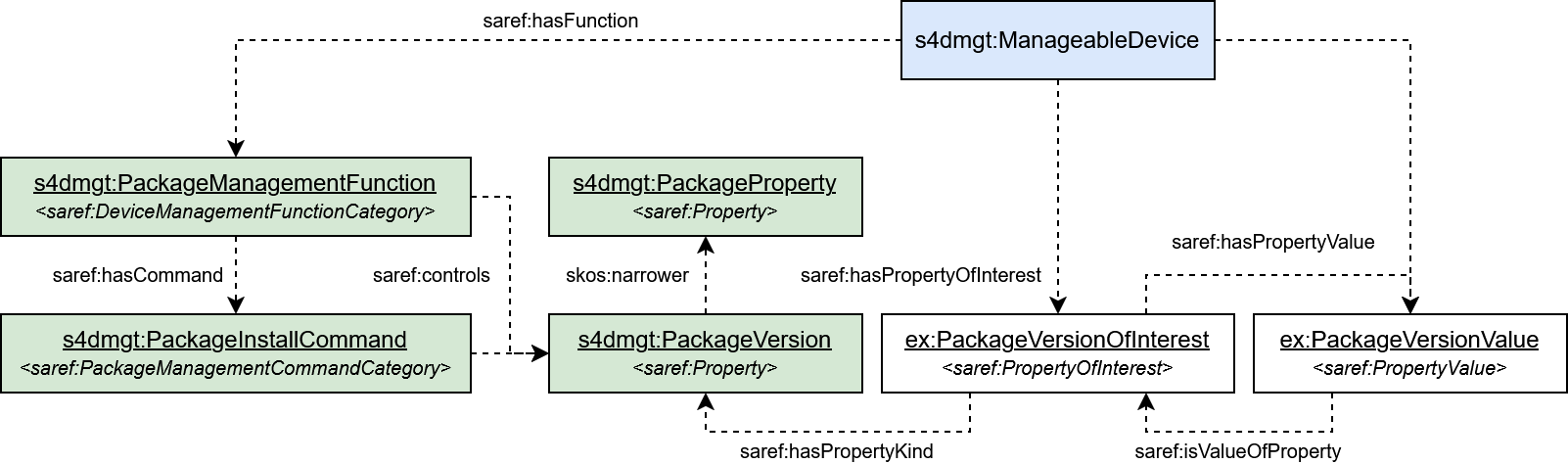
This resource follows its own lifecycle (see Figure 5), with the following states that specialize the s4dmgt:DevicePackageState: s4dmgt:DevicePackageInitialized, s4dmgt:DevicePackageDownloading, s4dmgt:DevicePackageDownloaded, s4dmgt:DevicePackageValidated, s4dmgt:DevicePackageInstalling, s4dmgt:DevicePackageInstalled, s4dmgt:DevicePackageUninstalling, s4dmgt:DevicePackageUninstalled.
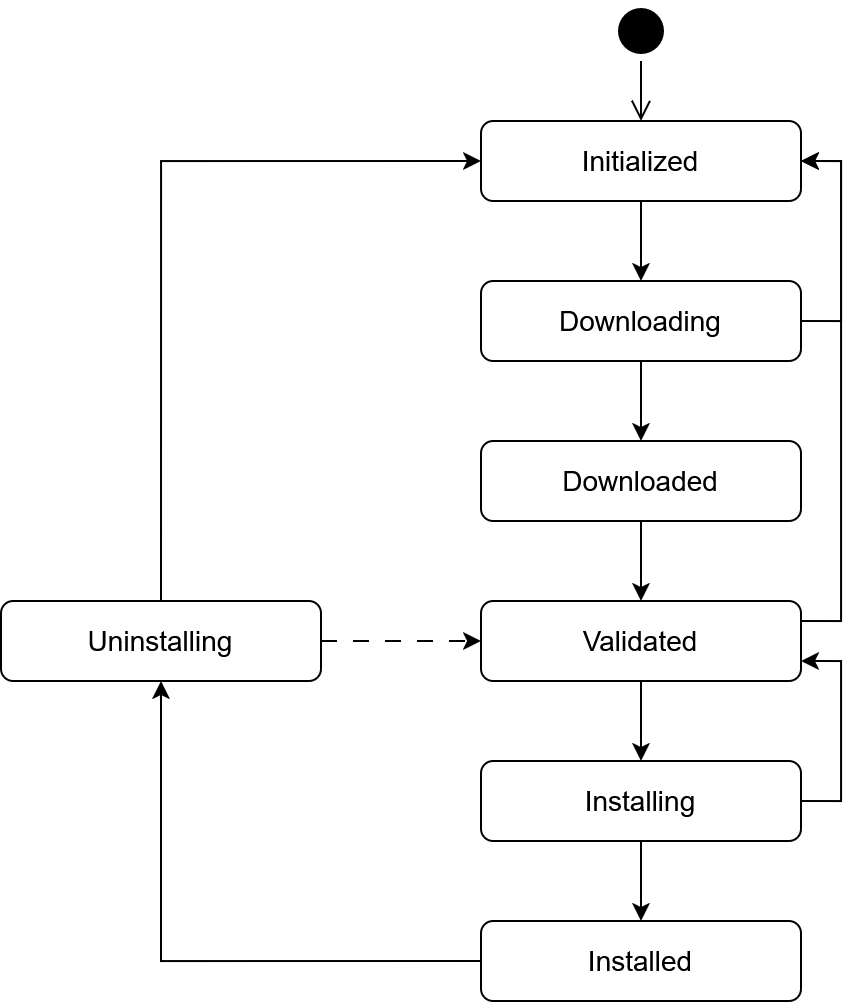
A property associated with the s4dmgt:PackageManagementFunction function has a relationship skos:narrower with the property s4dmgt:PackageProperty. The list of identified properties comprises the following individual: s4dmgt:PackageName, s4dmgt:PackageVersion.
The commands associated with the s4dmgt:PackageManagementFunction specialize the s4dmgt:PackageManagementCommandCategory, and comprise the following individuals: s4dmgt:PackageInformationRetrievalCommand, s4dmgt:PackageCreationCommand, s4dmgt:PackageDeletionCommand, s4dmgt:PackageDiscoveryCommand, s4dmgt:PackageUpdateCommand, s4dmgt:PackageDownloadCommand, s4dmgt:PackageInstallCommand, s4dmgt:PackageUninstallCommand.
Module
The s4dmgt:ModuleManagementFunction (see Figure 6) enables the management of modules for a device. A s4dmgt:DeviceModule is a saref:FeatureOfInterest that represents an executable software entity on the device. The Device Module implements specific Functions that are available to the Device when the Device Module is activated. It may result from a package installation: deleting the corresponding Device Package will in turn remove the Device Module and its related Functions. This dependency is represented through the object properties s4dmgt:enablesDeviceModule, and its inverse s4dmgt:hasDevicePackage.
This resource follows its own lifecycle, with the following states that specialize the s4dmgt:DeviceModuleState: s4dmgt:DeviceModuleActivated, s4dmgt:DeviceModuleDeactivated.
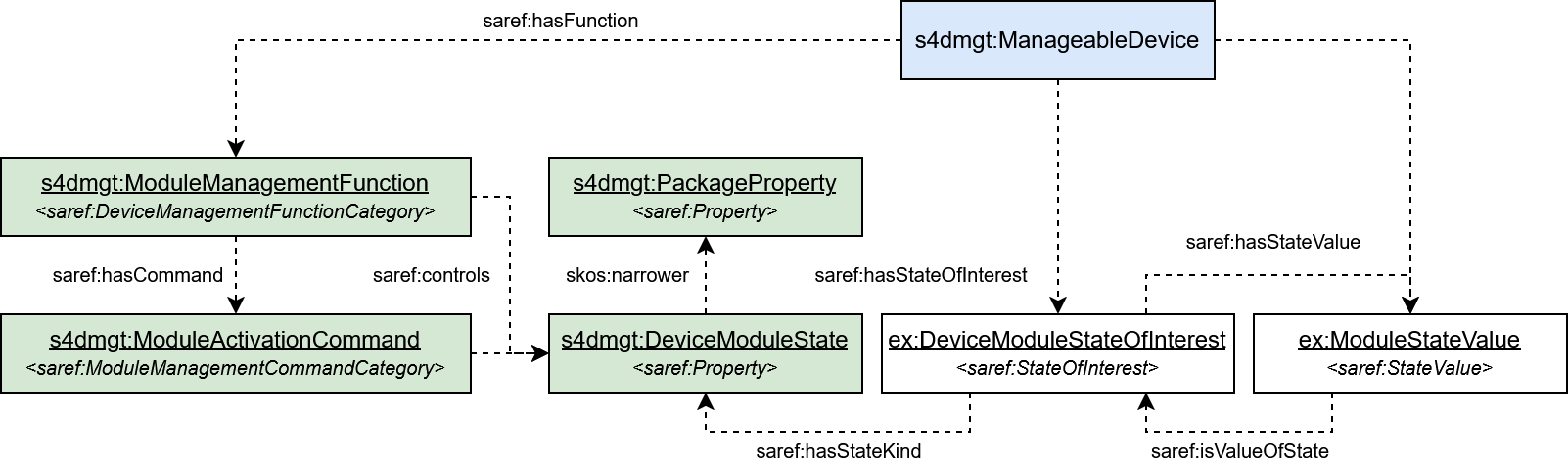
A property associated with the s4dmgt:ModuleManagementFunction function has a relationship skos:narrower with the property s4dmgt:ModuleProperty. The list of identified properties comprises the following individual: s4dmgt:ModuleName, s4dmgt:ModuleVersion.
The commands associated with the s4dmgt:ModuleManagementFunction specialize the s4dmgt:ModuleManagementCommandCategory, and comprise the following individuals: s4dmgt:ModuleInformationRetrievalCommand, s4dmgt:ModuleDiscoveryCommand, s4dmgt:ModuleActivationCommand, s4dmgt:ModuleDeactivationCommand.
Device Control
The s4dmgt:DeviceControlFunction enables the control the global state of the device, e.g. its power state through the Reboot function, or the global configuration through the Reset function.
No property is associated to this function.
The commands associated with the s4dmgt:DeviceControlFunction specialize the s4dmgt:DeviceControlCommandCategory, and comprise the following individuals: s4dmgt:RebootCommand, and s4dmgt:ResetCommand. This list is not exhaustive and is meant to be extended depending on the requirements of the Device Management Operator and their fleet.
Datamodels, technical representation of capabilities
General overview
The Datamodel is a commonly adopted solution to represent and manipulate device capabilities for Device Management protocols. For instance, CWMP and USP rely on the Technical Report 181 (TR-181 [5]), while LwM2M specifies its own datamodel, split into objects defined in the LwM2M Registries [i.1].
Datamodels are hierarchical structures composed of parameters, coherently grouped through objects and/or tables. Two aspects can be defined for a datamodel: the Supported Datamodel, which represents the abstract capabilities of the device, and allows their discovery; and the Datamodel Parameters, which contain the current state of the device, and enables the manipulation of parameters and their values.
Datamodels are the basis for the representation of capabilities during the exchanges between Server and Client. Each of the parameters contained with a datamodel support a set of Primitives, i.e. the basic operations that are available for their manipulation. These primitives will for instance include the basic "Create", "Read", "Update", "Delete" operations and their corresponding names in the different protocols. Other identified primitives are the "Operate" primitive, which exclusively targets parameters representing executable functions; and "Subscribe", enabling automatic notifications, e.g. for value changes of a parameter.
For instance, to retrieve the value for the "Manufacturer" property of the Device Identity, the parameter path will be defined hierarchically for both USP and LwM2M. For USP, it is retrieved through a "Get" Request targeting the path "Device.DeviceInfo.Manufacturer", to retrieve a string with a maximum length of 64. In that case, "Device" is the root object containing the whole datamodel, "DeviceInfo" is an object containing the parameters related to the Device Identity, and "Manufacturer" is a string-valued parameter within this "DeviceInfo" object. For LwM2M, this value is retrieved through a "Get" Request targeting the path "/3/0/0". "/" is the root of the datamodel, "/3" represents the "Device" object, "/3/0" represents the first and unique instance of the "Device" object, and "/3/0/0" represents the first parameter, whose name is "Manufacturer".
The Ontology defines both the s4dmgt:SupportedDatamodelFunction and the s4dmgt:DatamodelParameterFunction to represent this low-level manipulation of resources.
Supported datamodel
The s4dmgt:SupportedDatamodelFunction (see Figure 7) enables the manipulation of the supported datamodel of a Device. This represents the supported capabilities of that device, i.e. the available parameters and operations on these parameters.
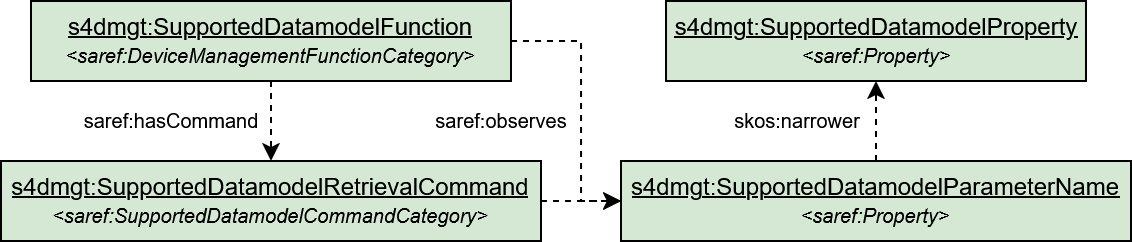
A property associated with the s4dmgt:SupportedDatamodelFunction function has a relationship skos:narrower with the property s4dmgt:SupportedDatamodelParameterProperty. The list of identified properties comprises the following individual: s4dmgt:SupportedDatamodelParameterName, s4dmgt:SupportedDatamodelParameterType, and s4dmgt:SupportedDatamodelParameterPrimitives.
The commands associated with the s4dmgt:SupportedDatamodelFunction specialize the s4dmgt:SupportedDatamodelCommandCategory, and comprise the following individuals: s4dmgt:SupportedDatamodelRetrievalCommand.
Datamodel parameters
The s4dmgt:DatamodelParameterFunction (see Figure 8) enables the manipulation of the datamodel parameter instances of a Device. The datamodel parameter instances represent the current state of each device capability and their configurations.
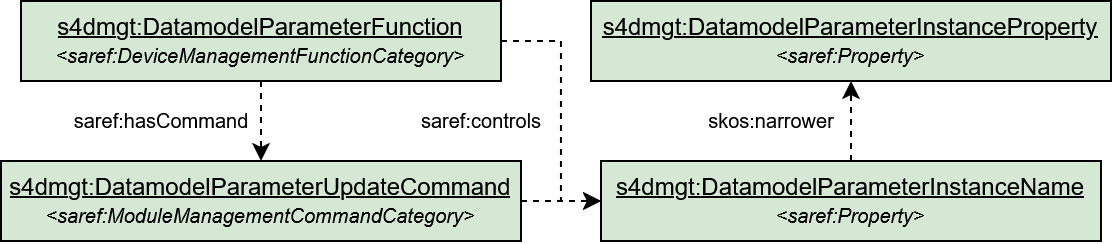
A property associated with the s4dmgt:DatamodelParameterFunction function has a relationship skos:narrower with the property s4dmgt:DatamodelParameterInstanceProperty. The list of identified properties comprises the following individual: s4dmgt:DatamodelParameterInstanceName, s4dmgt:DatamodelParameterInstanceValue.
The commands associated with the s4dmgt:DatamodelParameterFunction specialize the s4dmgt:DatamodelParameterCommandCategory, and comprise the following individuals: s4dmgt:DatamodelParameterCreationCommand, s4dmgt:DatamodelParameterDeletionCommand, s4dmgt:DatamodelParameterRetrievalCommand, s4dmgt:DatamodelParameterUpdateCommand, s4dmgt:DatamodelParameterOperateCommand.
Ontology Reference
Classes
- s4dmgt:Client
- s4dmgt:DatamodelParameterCommandCategory
- s4dmgt:DeviceControlCommandCategory
- s4dmgt:DeviceIdentityCommandCategory
- s4dmgt:DeviceManagementCommandCategory
- s4dmgt:DeviceManagementFunctionCategory
- s4dmgt:DeviceManagementState
- s4dmgt:DeviceModule
- s4dmgt:DeviceModuleState
- s4dmgt:DevicePackage
- s4dmgt:DevicePackageState
- s4dmgt:FirmwareManagementCommandCategory
- s4dmgt:ManageableDevice
- s4dmgt:ManagementConnection
- s4dmgt:ManagementService
- s4dmgt:ModuleManagementCommandCategory
- s4dmgt:PackageManagementCommandCategory
- s4dmgt:Server
- s4dmgt:SupportedDatamodelCommandCategory
s4dmgt:Client — Client top Classes ToC
Software entity which represents a Device by exposing its DM Functions to one or more DM Server(s).
It is responsible for the triggering of the DM Functions when a Command targeting the represented Device is received by the Server. The Client is also responsible for the reporting of the results of the Function execution to the Server.
The Client has an identifier that is unique only relatively to each Server it is connected to.
- has super-classes
- s4syst:System
- is in domain of
-
s4dmgt:connectedToServer
s4dmgt:representsDevice - is in range of
-
s4dmgt:hasConnectedClient
s4dmgt:isRepresentedBy
s4dmgt:DatamodelParameterCommandCategory — Datamodel Parameter Command Category top Classes ToC
Category of commands enabling the manipulation of one or more Datamodel Parameters.
s4dmgt:DeviceControlCommandCategory — Device Control Command Category top Classes ToC
Category of commands enabling the manipulation of the device state, for instance the power state with a Reboot or Shutdown command.
- has super-classes
- s4dmgt:DeviceManagementCommandCategory
- has members
- s4dmgt:RebootCommand, s4dmgt:ResetCommand
s4dmgt:DeviceIdentityCommandCategory — Device Identity Command Category top Classes ToC
Category of commands enabling the manipulation of device identification properties.
- has super-classes
- s4dmgt:DeviceManagementCommandCategory
- has members
- s4dmgt:DeviceInfoRetrievalCommand
s4dmgt:DeviceManagementCommandCategory — Device Management Command Category top Classes ToC
Category of Commands that are specific to the Device Management domain.
- has super-classes
- saref:Command
- has sub-classes
-
s4dmgt:DatamodelParameterCommandCategory
s4dmgt:DeviceControlCommandCategory
s4dmgt:DeviceIdentityCommandCategory
s4dmgt:FirmwareManagementCommandCategory
s4dmgt:ModuleManagementCommandCategory
s4dmgt:PackageManagementCommandCategory
s4dmgt:SupportedDatamodelCommandCategory
s4dmgt:DeviceManagementFunctionCategory — Device Management Function Category top Classes ToC
Category of Functions related to the Device Management domain.
These Functions correspond to the capabilities of the Device to perform its own diagnostics, maintenance, configuration, monitoring and control.
s4dmgt:DeviceManagementState — Device Management State top Classes ToC
This is a class of states for Device Management.
- has super-classes
- saref:State
- has sub-classes
-
s4dmgt:DeviceModuleState
s4dmgt:DevicePackageState
s4dmgt:DeviceModule — Device Module top Classes ToC
A DeviceModule is an executable software entity on the Device, i.e. a DeviceModule may be activated and deactivated on demand through dedicated Functions.
As such, the DeviceModule implements specific Functions that are available to the Device when the DeviceModule is activated.
A DeviceModule may be supported by a DevicePackage: deleting the corresponding DevicePackage will in turn remove the DeviceModule and its related Functions.
- has super-classes
- saref:FeatureOfInterest
s4dmgt:DeviceModuleState — Device Module State top Classes ToC
State of a DeviceModule
- has super-classes
- s4dmgt:DeviceManagementState
- is disjoint with
- s4dmgt:DevicePackageState
- has members
- s4dmgt:DeviceModuleActivated, s4dmgt:DeviceModuleDeactivated
s4dmgt:DevicePackage — Device Package top Classes ToC
A DevicePackage is an archive file that may contain resource files, code, libraries or executable files.
It is a resource that the Device should retrieve or receive from an external source.
A DevicePackage is only actionable once it has been downloaded and installed.
It may allow a Device to support additional Functions by instantiating a DeviceModule.
A DevicePackage may be uninstalled and then removed from the Device.
- has super-classes
- saref:FeatureOfInterest
s4dmgt:DevicePackageState — Device Package State top Classes ToC
State of a DevicePackage
- has super-classes
- s4dmgt:DeviceManagementState
- is disjoint with
- s4dmgt:DeviceModuleState
- has members
- s4dmgt:DevicePackageDownloaded, s4dmgt:DevicePackageDownloading, s4dmgt:DevicePackageInitialized, s4dmgt:DevicePackageInstalled, s4dmgt:DevicePackageInstalling, s4dmgt:DevicePackageUninstalling, s4dmgt:DevicePackageValidated
s4dmgt:FirmwareManagementCommandCategory — Firmware Management Command Category top Classes ToC
Category of commands enabling the manipulation of device firmwares.
- has super-classes
- s4dmgt:DeviceManagementCommandCategory
- has members
- s4dmgt:FirmwareInformationRetrievalCommand, s4dmgt:FirmwareUpdateCommand
s4dmgt:ManageableDevice — Manageable Device top Classes ToC
A tangible object that has at least one Device Management Function.
This class extends the saref:Device class, it is a Feature of Interest by definition.
- has super-classes
- saref:Device
- is in domain of
- s4dmgt:isRepresentedBy
- is in range of
- s4dmgt:representsDevice
s4dmgt:ManagementConnection — Management Connection top Classes ToC
Abstract representation of the connection between a Client and a Server. It does not necessarily imply that a persistent connection is established between the entities - such as a TCP connection. It represents the link and the capability of the Server to interact with the Client.
For instance, the Client has been authenticated by the Server with a certificate, and/or the client has received a configuration for access rights to its functions for the Server.
- has super-classes
- s4syst:Connection and ( s4syst:connectsSystem some s4dmgt:Client) and ( s4syst:connectsSystem some s4dmgt:Server)
- is in domain of
- s4dmgt:enablesManagementService
- is in range of
- s4dmgt:hasConnection
s4dmgt:ManagementService — Management Service top Classes ToC
A saref:Service that represents functions or functions of interest of the Device Management Function Category.
The ManagementService exposes these functions through a Connection, between a Client and a Server.
- has super-classes
- saref:Service
- is in domain of
- s4dmgt:hasConnection
- is in range of
- s4dmgt:enablesManagementService
s4dmgt:ModuleManagementCommandCategory — Module Management Command Category top Classes ToC
Category of commands enabling the manipulation of device modules.
s4dmgt:PackageManagementCommandCategory — Package Management Command Category top Classes ToC
Category of commands enabling the manipulation of device packages.
- has super-classes
- s4dmgt:DeviceManagementCommandCategory
- has members
- s4dmgt:PackageCreationCommand, s4dmgt:PackageDeletionCommand, s4dmgt:PackageDiscoveryCommand, s4dmgt:PackageDownloadCommand, s4dmgt:PackageInformationRetrievalCommand, s4dmgt:PackageInstallCommand, s4dmgt:PackageUninstallCommand, s4dmgt:PackageUpdateCommand
s4dmgt:Server — Server top Classes ToC
A DM Server is the software entity which is responsible for performing DM operations on a fleet of Devices. It exposes the set of available operations to an entity that needs to trigger an operation, such as a manufacturer or a Customer Care service.
The DM Server is a endpoint, generally secured, with which DM Clients communicate.
The protocol used between Server and Client is not in the scope of this ontology. It can follow a DM standard such as CWMP or LwM2M, or be completely proprietary.
- has super-classes
- s4syst:System
- is in domain of
- s4dmgt:hasConnectedClient
- is in range of
- s4dmgt:connectedToServer
s4dmgt:SupportedDatamodelCommandCategory — Supported Datamodel Command Category top Classes ToC
Category of commands enabling the manipulation of supported datamodels.
- has super-classes
- s4dmgt:DeviceManagementCommandCategory
- has members
- s4dmgt:SupportedDatamodelRetrievalCommand
Object Properties
s4dmgt:connectedToServer — connected to server top Object Properties ToC
Relationship between a Client and a Server when the Client is connected and authenticated to a Server, enabling the exposition of its DM Functions. This relationship could be inferred when a Management Service connects both the Client and the Server. Inverse of saref4dmgt:hasConnectedClient.
- has super-properties
- s4syst:connectedTo
- has domain
- s4dmgt:Client
- has range
- s4dmgt:Server
- is inverse of
- s4dmgt:hasConnectedClient
s4dmgt:enablesDeviceModule — enables device module top Object Properties ToC
A relationship between a DevicePackage and a DeviceModule that represents the fact that the DeviceModule only exists thanks to the DevicePackage. If the DevicePackage is uninstalled, the DeviceModule does not exist anymore.
- is inverse of
- s4dmgt:hasDevicePackage
s4dmgt:enablesManagementService — enables management service top Object Properties ToC
A relationship between a Management Service and Management Connection that represents the fact that a Management Service only exists thanks to the Management Connection. If the Management Connection is closed, the Management Service does not exist anymore.
- has domain
- s4dmgt:ManagementConnection
- has range
- s4dmgt:ManagementService
- is inverse of
- s4dmgt:hasConnection
s4dmgt:hasConnectedClient — has connected client top Object Properties ToC
Relationship between a Server and a Client when the Client is connected and authenticated to the Server, enabling the exposition of its DM Functions. This relationship could be inferred when a Management Service connects both the Client and the Server. Inverse of saref4dmgt:connectedToServer.
- has super-properties
- s4syst:connectedTo
- has domain
- s4dmgt:Server
- has range
- s4dmgt:Client
- is inverse of
- s4dmgt:connectedToServer
s4dmgt:hasConnection — has connection top Object Properties ToC
A relationship between a Management Service and a Management Connection, indicating that the Management Service exists solely because of the Management Connection. If the Management Connection ceases to exist, the Management Service will also cease to exist..
- has domain
- s4dmgt:ManagementService
- has range
- s4dmgt:ManagementConnection
- is inverse of
- s4dmgt:enablesManagementService
s4dmgt:hasDevicePackage — has device package top Object Properties ToC
A relationship between a DeviceModule and a DevicePackage that represents the fact that the DeviceModule only exists thanks to the DevicePackage. If the DevicePackage is uninstalled, the DeviceModule does not exist anymore.
- is inverse of
- s4dmgt:enablesDeviceModule
s4dmgt:isRepresentedBy — is represented by top Object Properties ToC
A relationship between a Manageable Device and one of the Clients that expose its DM functions to DM servers.
- has domain
- s4dmgt:ManageableDevice
- has range
- s4dmgt:Client
- is inverse of
- s4dmgt:representsDevice
s4dmgt:representsDevice — represents device top Object Properties ToC
A relationship between a Client and the Device whose DM functions the Client exposes to DM servers.
- has domain
- s4dmgt:Client
- has range
- s4dmgt:ManageableDevice
- is inverse of
- s4dmgt:isRepresentedBy
Named Individuals
- s4dmgt:DatamodelParameterCreationCommand
- s4dmgt:DatamodelParameterDeletionCommand
- s4dmgt:DatamodelParameterFunction
- s4dmgt:DatamodelParameterInstanceName
- s4dmgt:DatamodelParameterInstanceProperty
- s4dmgt:DatamodelParameterInstanceValue
- s4dmgt:DatamodelParameterOperateCommand
- s4dmgt:DatamodelParameterRetrievalCommand
- s4dmgt:DatamodelParameterUpdateCommand
- s4dmgt:DeviceControlFunction
- s4dmgt:DeviceIdentityFunction
- s4dmgt:DeviceIdentityProperty
- s4dmgt:DeviceInfoRetrievalCommand
- s4dmgt:DeviceModuleActivated
- s4dmgt:DeviceModuleDeactivated
- s4dmgt:DevicePackageDownloaded
- s4dmgt:DevicePackageDownloading
- s4dmgt:DevicePackageInitialized
- s4dmgt:DevicePackageInstalled
- s4dmgt:DevicePackageInstalling
- s4dmgt:DevicePackageUninstalling
- s4dmgt:DevicePackageValidated
- s4dmgt:FirmwareInformationRetrievalCommand
- s4dmgt:FirmwareManagementFunction
- s4dmgt:FirmwareProperty
- s4dmgt:FirmwareUpdateCommand
- s4dmgt:FirmwareVersion
- s4dmgt:HardwareVersion
- s4dmgt:Manufacturer
- s4dmgt:ModelName
- s4dmgt:ModelNumber
- s4dmgt:ModuleActivationCommand
- s4dmgt:ModuleDeactivationCommand
- s4dmgt:ModuleDiscoveryCommand
- s4dmgt:ModuleInformationRetrievalCommand
- s4dmgt:ModuleManagementFunction
- s4dmgt:ModuleName
- s4dmgt:ModuleProperty
- s4dmgt:ModuleVersion
- s4dmgt:PackageCreationCommand
- s4dmgt:PackageDeletionCommand
- s4dmgt:PackageDiscoveryCommand
- s4dmgt:PackageDownloadCommand
- s4dmgt:PackageInformationRetrievalCommand
- s4dmgt:PackageInstallCommand
- s4dmgt:PackageManagementFunction
- s4dmgt:PackageName
- s4dmgt:PackageProperty
- s4dmgt:PackageUninstallCommand
- s4dmgt:PackageUpdateCommand
- s4dmgt:PackageVersion
- s4dmgt:RebootCommand
- s4dmgt:ResetCommand
- s4dmgt:SerialNumber
- s4dmgt:SupportedDatamodelFunction
- s4dmgt:SupportedDatamodelParameterName
- s4dmgt:SupportedDatamodelParameterPrimitives
- s4dmgt:SupportedDatamodelParameterProperty
- s4dmgt:SupportedDatamodelParameterType
- s4dmgt:SupportedDatamodelRetrievalCommand
s4dmgt:DatamodelParameterCreationCommand — Datamodel parameter creation command top Named Individuals ToC
Command to create a datamodel parameter instance.
s4dmgt:DatamodelParameterDeletionCommand — Datamodel parameter deletion command top Named Individuals ToC
Command to delete a datamodel parameter instance.
s4dmgt:DatamodelParameterFunction — Datamodel parameter function top Named Individuals ToC
Function kind for the manipulation of datamodel parameters.
s4dmgt:DatamodelParameterInstanceName — Datamodel parameter instance name top Named Individuals ToC
Name for an instance of a datamodel parameter.
s4dmgt:DatamodelParameterInstanceProperty — Datamodel parameter instance property top Named Individuals ToC
Property kind that represents the properties of a Datamodel Parameter Instance.
These parameter instances represent the actionable capabilities of the Device in a format specific to the datamodel implemented by the Device, and exposed by the Client.
It should not be confused with the Supported Datamodel Parameter, which represents the abstract capabilities of the Device.
s4dmgt:DatamodelParameterInstanceValue — Datamodel parameter instance value top Named Individuals ToC
Value of a datamodel parameter instance, obtained as the result of the execution of a Datamodel parameter retrieval command.
s4dmgt:DatamodelParameterOperateCommand — Datamodel parameter operate command top Named Individuals ToC
Command to trigger the execution of a datamodel parameter instance that corresponds to an executable process on a device.
s4dmgt:DatamodelParameterRetrievalCommand — Datamodel parameter retrieval command top Named Individuals ToC
Command to retrieve the value of a Datamodel parameter instance.
s4dmgt:DatamodelParameterUpdateCommand — Datamodel parameter update command top Named Individuals ToC
Command to update the value of a Datamodel parameter instance.
s4dmgt:DeviceControlFunction — Device control function top Named Individuals ToC
Function kind to control the global state of the device, e.g. its power state through the Reboot function, or the global configuration through the Reset function.
s4dmgt:DeviceIdentityFunction — Device identity function top Named Individuals ToC
Function kind that represents the capabilities of a device to expose its own identity.
s4dmgt:DeviceIdentityProperty — Device identity property top Named Individuals ToC
Set of properties that constitutes a Device Identity.
s4dmgt:DeviceInfoRetrievalCommand — Device info retrieval command top Named Individuals ToC
A command to retrieve any Device identity property.
s4dmgt:DeviceModuleActivated — Device module activated top Named Individuals ToC
State of a Device Module whose related functions were made available on a device, either automatically after the Device Module installation, or through a Module activation command.
- belongs to
- s4dmgt:DeviceModuleState
s4dmgt:DeviceModuleDeactivated — Device module deactivated top Named Individuals ToC
State of a Device Module whose related functions were made unavailable through a Module Deactivation Command.
- belongs to
- s4dmgt:DeviceModuleState
s4dmgt:DevicePackageDownloaded — Device package downloaded top Named Individuals ToC
State of a Device Package whose set of required files are available of on the device, either through a download process from a Client, or an upload process from a Server. This is a transitory state, that changes to the either the Device Package Validated state, or returns to the Device Package Initialized state in case of error.
- belongs to
- s4dmgt:DevicePackageState
s4dmgt:DevicePackageDownloading — Device package downloading top Named Individuals ToC
State of a Device Package that represents that the process of transferring the required package files is in progress. This state is attained through the Device Package Initialized state either automatically, or through the execution of a Package Download Command. This is a transitory state, that changes to either the Device Package Downloaded or returns to the Device Package Initialized state in case of error.
- belongs to
- s4dmgt:DevicePackageState
s4dmgt:DevicePackageInitialized — Device package initialized top Named Individuals ToC
State of a Device Package that represents that the process of creating the required package on the device. This state is attained through the execution of the Package Creation Command. This may be a transitory state, that changes to the Device Package Downloading state automatically.
- belongs to
- s4dmgt:DevicePackageState
s4dmgt:DevicePackageInstalled — Device package installed top Named Individuals ToC
State of a Device package whose resources have been made ready for their final purpose, after the download and install processes are completed.
- belongs to
- s4dmgt:DevicePackageState
s4dmgt:DevicePackageInstalling — Device package installing top Named Individuals ToC
State of a Device Package that represents that the process of readying the required package files is in progress. This state is attained through the execution of the Package Install Command, from the Device Package Validated state. This is a transitory state, that changes to the Device Package Installed state, or returns to the Device Package Validated state in case of error.
- belongs to
- s4dmgt:DevicePackageState
s4dmgt:DevicePackageUninstalling — Device package uninstalling top Named Individuals ToC
State of a Device Package that represents that the process of removing the associated package files is in progress. This is a transitory state, that either changes to the Device Package Initialized or Device Package Validated states depending on implementation.
- belongs to
- s4dmgt:DevicePackageState
s4dmgt:DevicePackageValidated — Device package validated top Named Individuals ToC
State of a Device Package that represents that the required package files are available on the device, and actually correspond to the expected files, without corruption. The transition from the Device Package Downloaded state is automatic, and depends on the client and package implementations.
- belongs to
- s4dmgt:DevicePackageState
s4dmgt:FirmwareInformationRetrievalCommand — Firmware information retrieval command top Named Individuals ToC
Command to retrieve firmware information such as the current firmware version for a device.
s4dmgt:FirmwareManagementFunction — Firmware management function top Named Individuals ToC
Set of functions related to the management of the firmware for a device.
s4dmgt:FirmwareProperty — Firmware property top Named Individuals ToC
Property kind that represents the properties of the firmware of a device.
The device firmware is the running base software for a device, which is automatically loaded into memory and executed at boot.
- belongs to
- saref:Property
- skos:broader
- s4dmgt:FirmwareVersion
s4dmgt:FirmwareUpdateCommand — Firmware update command top Named Individuals ToC
Command to trigger the update of the firmware of a device.
s4dmgt:FirmwareVersion — Firmware version top Named Individuals ToC
The firmware version of a device.
- belongs to
- saref:Property
- skos:narrower
- s4dmgt:FirmwareProperty
s4dmgt:HardwareVersion — Hardware version top Named Individuals ToC
Device identity property referring to the specific version of the set of physical components of a device, known as hardware version.
s4dmgt:Manufacturer — Manufacturer top Named Individuals ToC
Device identity property representing the manufacturer of the device.
s4dmgt:ModelName — Model name top Named Individuals ToC
Device identity property that represents the device model, i.e. the denomination for a specific hardware design for this device, in a human-readable format.
s4dmgt:ModelNumber — Model number top Named Individuals ToC
The unique identifier assigned to a device model, used to distinguish it from other models and versions within a manufacturer's product lineup.
s4dmgt:ModuleActivationCommand — Module activation command top Named Individuals ToC
Command to trigger the activation of a Device Module.
- belongs to
- s4dmgt:ModuleManagementCommandCategory
s4dmgt:ModuleDeactivationCommand — Module deactivation command top Named Individuals ToC
Command to trigger the deactivation of a Device Module.
- belongs to
- s4dmgt:ModuleManagementCommandCategory
s4dmgt:ModuleDiscoveryCommand — Module discovery command top Named Individuals ToC
Command to retrieve the list of Device Modules available on a device.
s4dmgt:ModuleInformationRetrievalCommand — Module information retrieval command top Named Individuals ToC
Command to retrieve device module information such as the name of the module or its version.
s4dmgt:ModuleManagementFunction — Module management function top Named Individuals ToC
Function kind for the management of Device Modules.
s4dmgt:ModuleName — Module name top Named Individuals ToC
The name of a device module.
- belongs to
- saref:Property
- skos:narrower
- s4dmgt:ModuleProperty
s4dmgt:ModuleProperty — Module property top Named Individuals ToC
Property kind that represents the properties of a Device Module.
s4dmgt:ModuleVersion — Module version top Named Individuals ToC
The version of a Device Module.
- belongs to
- saref:Property
- skos:narrower
- s4dmgt:ModuleProperty
s4dmgt:PackageCreationCommand — Package creation command top Named Individuals ToC
Command to trigger the creation of a Device Package on a device.
s4dmgt:PackageDeletionCommand — Package deletion command top Named Individuals ToC
Command to trigger the deletion of a Device Package on a device.
s4dmgt:PackageDiscoveryCommand — Package discovery command top Named Individuals ToC
Command to retrieve the list of available Device Packages on a device.
s4dmgt:PackageDownloadCommand — Package download command top Named Individuals ToC
Command to trigger the download of a Device Package in the Device Package Initialized state.
s4dmgt:PackageInformationRetrievalCommand — Package information retrieval command top Named Individuals ToC
Command to retrieve device package information such as the name of the package or its version.
s4dmgt:PackageInstallCommand — Package install command top Named Individuals ToC
Command to trigger the installation of Device Package on a device.
s4dmgt:PackageManagementFunction — Package management function top Named Individuals ToC
Function kind related to the management of Device Packages on a device.
- belongs to
- s4dmgt:DeviceManagementFunctionCategory
- saref:hasCommand
- s4dmgt:PackageCreationCommand, s4dmgt:PackageDeletionCommand, s4dmgt:PackageDiscoveryCommand, s4dmgt:PackageDownloadCommand, s4dmgt:PackageInformationRetrievalCommand, s4dmgt:PackageInstallCommand, s4dmgt:PackageUninstallCommand, s4dmgt:PackageUpdateCommand
s4dmgt:PackageName — Package name top Named Individuals ToC
The name of a Device Package.
- belongs to
- saref:Property
- skos:narrower
- s4dmgt:PackageProperty
s4dmgt:PackageProperty — Package property top Named Individuals ToC
Property kind that represents the properties of a DevicePackage
s4dmgt:PackageUninstallCommand — Package uninstall command top Named Individuals ToC
Command to trigger the uninstallation of a Device Package on a device.
s4dmgt:PackageUpdateCommand — Package update command top Named Individuals ToC
Command to trigger the update of a Device Package on a device. This corresponds to the action of replacing, on a device, a Device Package by another Device Package with the same name, but a different version.
s4dmgt:PackageVersion — Package version top Named Individuals ToC
The version of a device package.
- belongs to
- saref:Property
- skos:narrower
- s4dmgt:PackageProperty
s4dmgt:RebootCommand — Reboot command top Named Individuals ToC
Command to trigger the reboot process of a device.
- belongs to
- s4dmgt:DeviceControlCommandCategory
s4dmgt:ResetCommand — Reset command top Named Individuals ToC
Command to change the entire state of a device and its resources to another state as predefined according to the device manufacturer policy.
- belongs to
- s4dmgt:DeviceControlCommandCategory
s4dmgt:SerialNumber — Serial number top Named Individuals ToC
Device identity property referring to the unique identifier assigned to an individual device, used for tracking, warranty, and support purposes, distinguishing it from all other units produced.
s4dmgt:SupportedDatamodelFunction — Supported datamodel function top Named Individuals ToC
Function kind to manage the supported datamodel of a device.
s4dmgt:SupportedDatamodelParameterName — Supported datamodel parameter name top Named Individuals ToC
Name of a supported datamodel parameter.
s4dmgt:SupportedDatamodelParameterPrimitives — supported datamodel parameter primitives top Named Individuals ToC
Property of a supported datamodel parameter listing the different available primitives for the manipulation of the corresponding Datamodel parameter instance(s).
These primitives will for instance include the basic "Create", "Read", "Update", "Delete" operations and their corresponding names in the different Device Management protocols.
s4dmgt:SupportedDatamodelParameterProperty — Supported datamodel parameter property top Named Individuals ToC
Property kind that represents the properties of a Supported Datamodel Parameter.
These parameters represent the capabilities of the Device in a format specific to the datamodel implemented by the Device, and exposed by the Client.
It should not be confused with the Datamodel Parameter Instance, which represents the actionable capabilities of the Device.
s4dmgt:SupportedDatamodelParameterType — Supported datamodel parameter type top Named Individuals ToC
Type of a supported datamodel parameter.
For instance, this type can represent that the supported datamodel parameter is a reference to an executable resource. The corresponding type would be 'command' in the CWMP standard protocol, and its TR-181 technical report.
This type can represent a reference to a measurement process on the device that retrieves a value. In that case, the supported datamodel parameter also describes the unit of that value.
The type 'object' corresponds to a supported datamodel parameter that contains other supported datamodel parameters, creating a hierarchical structure.
A final example would be a 'table', i.e. the corresponding datamodel parameter is a list of instances of the same object.
For more information, please refer to the specification documents of DM protocol standards such as TR-181 from the BroadBand Forum.
s4dmgt:SupportedDatamodelRetrievalCommand — Supported datamodel retrieval command top Named Individuals ToC
Command to retrieve a supported datamodel parameter, which corresponds to the information required to access a datamodel parameter instance and interpret its value.
General Axioms
- All Disjoint Classes
- s4dmgt:DatamodelParameterCommandCategory, s4dmgt:DeviceControlCommandCategory, s4dmgt:DeviceIdentityCommandCategory, s4dmgt:FirmwareManagementCommandCategory, s4dmgt:ModuleManagementCommandCategory, s4dmgt:PackageManagementCommandCategory, s4dmgt:SupportedDatamodelCommandCategory
- All Different Individuals
- All Different Individuals
References
Normative references
- [0] ETSI TS 103 410-8 (V1.1.1): "DATA; Extension to SAREF; Part 15: Device Management Domain".
- [1] ETSI TS 103 264: "SmartM2M; Smart Applications; Reference Ontology and oneM2M Mapping".
- [2] ETSI TS 103 548: "SmartM2M; SAREF reference ontology patterns".
- [3] ETSI TS 103 673: "SmartM2M; SAREF Development Framework and Workflow, Streamlining the Development of SAREF and its Extensions".
- [4] BBF TR-069 Amendment 6 Corrigendum 1: "Broadband Forum, CPE WAN Management Protocol".
- [5] BBF TR-181 Issue 2 Amendment 20 Corrigendum 1: "TR-181 Device Data Model for CWMP Endpoints and USP Agents".
- [6] BBF TR-369 Issue 1 Amendment 4 Corrigendum 2: "Broadband Forum, The User Services Platform".
- [7] OMA-TS-LightweightM2M_Core-V1_2_2-20240613-A: "Lightweight Machine to Machine Technical Specification: Core".
- [8] oneM2M TS-0001: "Functional Architecture".
- [9] oneM2M TS-0005: "Management enablement (OMA)", v4.0.3.
- [10] oneM2M TS-0006: "Management enablement (BBF)", v4.0.1.
- [11] oneM2M TS-0014: "LwM2M Interworking", v4.0.1.
- [12] oneM2M TS-0023: "SDT based Information Model and Mapping for Vertical Industries", v5.7.0, section 5.8 Device Management.
Informative references
- [i.1] LwM2M Registries, objects and resources. Available at https://www.openmobilealliance.org/specifications/registries